SPECIES DESCRIPTION
LEPIDIUM VIRGINICUM
Family and Genus:- See- CRUCIFERAE/Sect. DILEPTIUM
Common Names:- None
Homotypic Synonyms:- Crucifera virginica, Dileptium virginicum, Iberis virginica,
Nasturtiastrum virginicum, Nasturtium virginicum, Thlaspi virginicum.
Meaning:- Lepidium. (Gr) From lepidion, meaning "little" or "small scale". referring
to the shape of the plant’s small, flat seed pods.
Virginicm (L) From the Virgin Islands.
General description:- Annual or biennial, usually branched above
Stem:-
1) 30-50 cm, erect, shortly pubescent.
Leaves:-
1) Basal, mostly withered before anthesis, serrate or pinnatisect to pinnatiparitite
10-80 x 5-15 mm,
2) Middle, smaller, oblanceolate, serrate.
3) Upper, all acute to apiculate.
Flowers:-
1) Racemes, with 20-60 flowers.
2) Pedicels, almost patent, 3~5 mm, in fruit, papillose on the upper side, glabrous
beneath.
3) Sepals, ovate-oblong with apically broad, whitish scarious margin-0.9-1.2 x
0.8-1 mm.
4) Petals, white, 0.8-1.5(2) mm, spathulate to clawed.
5) Stamens, 2-4.
6) Style, 0.1 - 0.2 mm, not exceeding the silicula's apticle notch.
Fruit:-
1) Siliculae, compressed, obovate to suborbicular, narrowly winged above-
3-4 x 2.5-3 mm.apticle notch broad but shallow.
Key Features:-
1) Apex of the infructescence with curved, somewhat appressed papillae
Habitat:- Weed of natural habits. 50-100 mtrs.
Distribution:- Native to Canada - Central America and the Caribbean. Introduced to
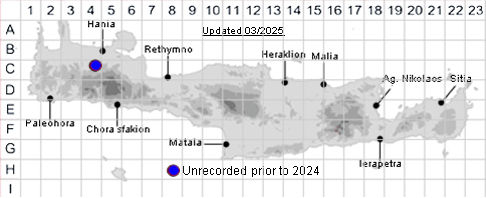
most of Europe and common in the Mediterranean region. Rare on Crete
Flowering time:- April - June
Photos by:- Christopher Cheiladakis